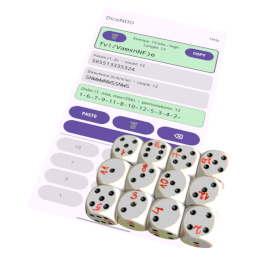
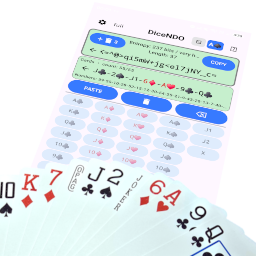
dicendoOffline deterministic password generation from physical dice or shuffled playing cards.
dicendo is a physical-randomness generator of very strong random
passwords that is easy to verify. It allows users to generate high-entropy passwords using only
physical randomness and publicly documented deterministic algorithms. It can use physical
randomness obtained by rolling standard six-sided dice or by shuffling a standard deck of
playing cards. It works entirely offline and does
not rely on any external data sources. In particular, it does not use the system random number
generator (RNG) for password generation; instead, it derives entropy entirely from physical
input entered by the user. The mapping from input to the final password is fully deterministic.
The process is under the user's full control and is publicly documented.
dicendo generates a password from three
separate dice-derived inputs, or from the order of a shuffled card deck:
1..6),N/E/S/W)1..n
To generate a good-quality password using only dice faces, at least
30 rolls are typically required, which corresponds to about
630 ≈ 2 * 1023 possible outcomes. The number
of required dice can be reduced when additional entropy sources are used. In
particular, for numbered dice, a comparable level of entropy can be obtained
with about 12 dice when faces, directions, and order are all taken
into account, giving approximately
612 * 412 * 12! ≈ 1.7 * 1025
possible states. For more details, see
Security model.
In cards mode, a shuffled deck is entered card by card. The application can use a standard 52-card deck, optional extra cards, or a reduced deck selected in options. The same deterministic conversion then maps the observed card order into the final password.
The name dicendo is derived from dice and the three
core input components of the method: N – numbers (faces),
D – directions, and O – order.
The Android application is an evolution of a personal Python script
originally written in 2021, combining and extending its functionality
into a single unified tool.
The dicendo documentation is structured so that you can choose
the level of detail that best matches your needs:
dicendo's security model for dice and cards, Get it on Google Play